

Surya Bhedana pranayama is a yogic breathing practice where you inhale through the right nostril and exhale through the left, traditionally called the sun-piercing breath. Studies on right-nostril-initiated breathing point to a stimulating effect, with heart rate and blood pressure measures rising instead of falling, so it behaves differently from calming techniques. This guide covers how to practice it, what the research found, and who should skip it.
Yoga Breathing Techniques for Beginners
What Is Surya Bhedana Pranayama?
Surya Bhedana pranayama is a breathing technique in which each round starts with an inhale through the right nostril and ends with an exhale through the left.
- “Surya” means sun, and “bhedana” means to pierce or pass through.
- Yogic tradition links the right nostril with Pingala nadi, the “solar” channel, which is described as warming and activating (Source: Bhavanani et al., 2014).
- It is also called right nostril breathing or the sun-piercing breath.
- The classic form includes an optional breath hold, but beginners usually skip it.
It is the mirror image of Chandra Bhedana, which starts on the left nostril and has the opposite reputation.
Why Does Surya Bhedana Pranayama Matter?
Surya Bhedana matters because it is one of the few breathing practices that research suggests is activating rather than calming, which changes who should use it and when.
- Right-nostril-initiated techniques raised heart rate and blood pressure measures in a lab study of yoga-trained adults (Source: Bhavanani et al., 2014).
- Left-nostril-initiated techniques did the opposite in the same study, so the starting nostril appears to matter.
- That makes Surya Bhedana a poor choice for winding down and a better fit for daytime practice, if it suits you at all.
- Knowing the difference helps you pick the right tool, and avoid the wrong one when your blood pressure or stress level is already high.
How Do You Practice Surya Bhedana Pranayama Step by Step?
To practice Surya Bhedana, close your left nostril, inhale slowly through the right, then close the right nostril and exhale slowly through the left.
Basic technique
- Sit upright on the floor or a chair with your spine tall and shoulders relaxed. Rest your left hand on your knee.
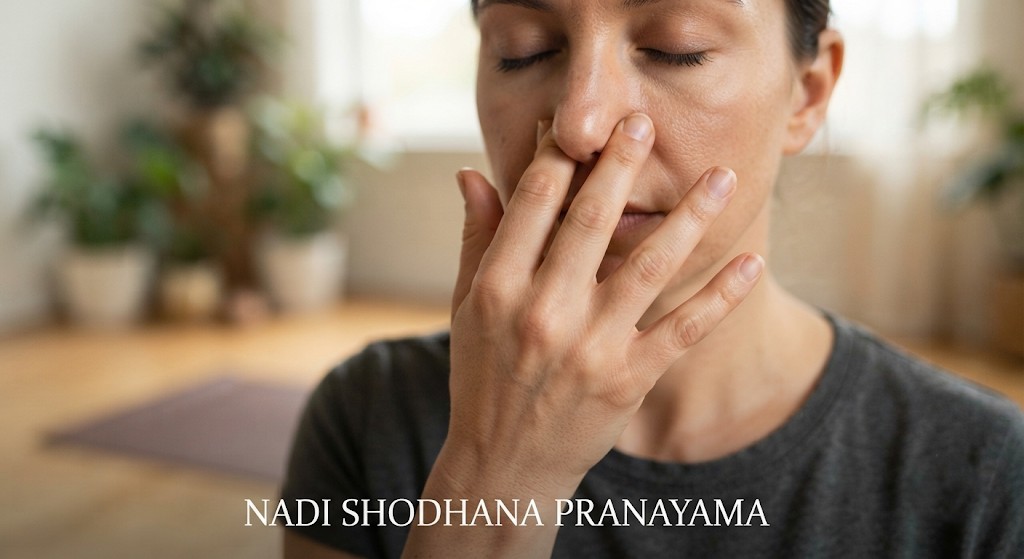
- Raise your right hand to your nose. Fold your index and middle fingers into your palm, with the thumb on the right nostril and the ring finger ready for the left.
- Close your left nostril with the ring finger.
- Inhale slowly and quietly through the right nostril.
- Close both nostrils briefly. Beginners can skip any breath hold and simply pause for a moment.
- Release the thumb and exhale slowly through the left nostril.
- That is one round. Repeat for 5 to 10 rounds, then breathe normally for a minute.
Breath ratio and rounds
- Start with an equal inhale and exhale, such as 4 counts in and 4 counts out.
- Once that feels easy, many teachers move to a longer exhale, such as 3 in and 6 out.
- Keep the breath smooth and silent. Forceful breathing is where most problems start.
- Practice on an empty stomach, as traditional guidance advises.
Sample beginner plan
This is a gentle starting point, not a clinical protocol. Adjust it to how you feel.
| Week | Rounds per session | Breath ratio (in:out) | Notes |
|---|---|---|---|
| 1 | 3 to 5 | 1:1 (4 in, 4 out) | Learn the hand position, skip breath holds |
| 2 | 5 to 7 | 1:2 (3 in, 6 out) | Keep the breath silent and smooth |
| 3 and after | 7 to 10 | 1:2 | Stop if you feel jittery, flushed or dizzy |
A short seated meditation afterward is a natural way to finish.
What Does Research Say About Surya Bhedana Pranayama?
Small studies suggest Surya Bhedana and other right-nostril techniques stimulate the sympathetic nervous system, raising heart rate, blood pressure and metabolic activity.
Heart rate and blood pressure
- In 20 yoga-trained adults, nine rounds of Surya Bhedana raised heart rate and blood pressure measures. Left-initiated techniques and Nadi Shodhana lowered them, and normal breathing changed nothing significant (Source: Bhavanani et al., 2014).
- Reaction time also got faster after Surya Bhedana, which fits with a more alert, activated state (Source: Bhavanani et al., 2014).
- The authors suggested that the nostril used for inhalation drives the effect more than the one used for exhalation.
- In 85 healthy students who practiced right nostril breathing for an hour a day over six weeks, indices of sympathetic activity and blood pressure rose. The authors cautioned against encouraging students to practice it (Source: Pal et al., 2014).
That last study used single-nostril breathing with equal inhale and exhale, and a far longer daily session than most people would ever do. It is not a direct test of Surya Bhedana, but it points in the same direction.
Metabolism and oxygen use
- In 48 men who practiced nostril-specific breathing 27 cycles at a time, four times a day for a month, baseline oxygen consumption rose by 37% in the right nostril group (Source: Telles et al., 1994).
- The left nostril group rose 24% and the alternate nostril group 18%, so the increase was not unique to the right side.
- The authors suggested the change could come from greater sympathetic discharge to the adrenal medulla (Source: Telles et al., 1994).
What these studies can’t tell you
- Most trials are small, short and done in healthy, often yoga-trained, volunteers.
- Few studies test the exact Surya Bhedana pattern, so some results come from related right-nostril techniques.
- No study here shows Surya Bhedana treats a medical condition.
- A 2025 meta-analysis of pranayama for mental disorders found adverse events were more common with fast breathing than slow breathing (Source: Mütze et al., 2025). Keeping your breath slow is the safer choice.
Who Should Avoid or Be Careful With Surya Bhedana Pranayama?
People with high blood pressure, heart disease, or a tendency toward anxiety should check with a healthcare professional before trying Surya Bhedana, since the research points to a stimulating effect.
- High or unstable blood pressure, and any heart condition.
- Fever, acute inflammation or stomach ulcers, which yoga teachers commonly list as reasons to skip it.
- Pregnancy, unless your doctor or an experienced teacher has approved it.
- Anxiety or panic that gets worse when you feel revved up.
- Hot weather or an overheated room, where the warming reputation of this practice is unhelpful.
If you feel flushed, jittery or lightheaded, stop and switch to a calming option such as Bhramari or alternate nostril breathing.
What Are the Most Common Surya Bhedana Mistakes?
The most common mistakes are forcing the breath, holding it too long and practicing at the wrong time, all of which push the body toward overstimulation.
- Breathing hard or noisily through the nose.
- Adding long breath holds before the basic pattern feels easy.
- Practicing right after a meal.
- Pressing too hard on the nostrils, or tensing the shoulders and hand.
- Practicing late at night, when a stimulating technique is least useful.
- Continuing through dizziness or a racing heart.
When Is the Best Time to Practice Surya Bhedana Pranayama?
The best time to practice Surya Bhedana is in the morning or early daytime, on an empty stomach, when a more alert state helps rather than gets in the way.
- Morning, before breakfast, as part of a short routine.
- Midday, if you need to shake off sluggishness and have not just eaten.
- Avoid it close to bedtime, and avoid it in hot weather or hot rooms.
Sun Salutation (Surya Namaskar)
How Does Surya Bhedana Compare With Chandra Bhedana and Nadi Shodhana?
Surya Bhedana is the activating option, Chandra Bhedana is its calming mirror, and Nadi Shodhana alternates between both sides with a balancing, steady feel.
| Practice | Inhale through | Exhale through | What studies suggest |
|---|---|---|---|
| Surya Bhedana | Right nostril | Left nostril | Heart rate and blood pressure measures rose |
| Chandra Bhedana | Left nostril | Right nostril | Heart rate and blood pressure measures fell |
| Nadi Shodhana | Alternates | Alternates | Heart rate and blood pressure measures fell |
Conclusion
Surya Bhedana pranayama is a slow right-in, left-out breathing practice that research links to higher heart rate, blood pressure and metabolic activity. That makes it a daytime technique for healthy people, and a poor match for anyone with blood pressure or heart concerns. Start with three to five gentle rounds on an empty stomach, keep the breath smooth, and stop if you feel off.
If you want more energy without the stimulation, pairing a short breathing practice with movement is a safer next step.
Morning Yoga for Energy and Flexibility
FAQs
What is Surya Bhedana pranayama?
It is a yogic breathing technique where you inhale through the right nostril and exhale through the left. The name means “sun-piercing breath”.
Is Surya Bhedana pranayama safe for beginners?
It can be, if you keep the breath slow, skip breath holds and practice on an empty stomach. People with blood pressure or heart problems should check with a doctor first.
Does Surya Bhedana raise blood pressure?
In small studies, right-nostril-initiated breathing raised blood pressure and heart rate measures. That is why people with hypertension are usually advised to avoid it.
How many rounds of Surya Bhedana should I do?
Start with 3 to 5 rounds and build up to 7 to 10 over a few weeks. More is not better, especially if you feel jittery or flushed.
When should I practice Surya Bhedana pranayama?
Mornings on an empty stomach suit it best. Avoid practicing it late at night or in hot weather.
Is Surya Bhedana the same as right nostril breathing?
They are closely related, but not identical. Surya Bhedana inhales through the right and exhales through the left, while single right nostril breathing uses the right nostril for both.
Sources
- Bhavanani, A. B., et al. (2014). Differential Effects of Uninostril and Alternate Nostril Pranayamas on Cardiovascular Parameters and Reaction Time. International Journal of Yoga.
- Telles, S., Nagarathna, R., & Nagendra, H. R. (1994). Breathing Through a Particular Nostril Can Alter Metabolism and Autonomic Activities. Indian Journal of Physiology and Pharmacology.
- Mütze, C., Mitzinger, D., & Haller, H. (2025). Effectiveness of Pranayama for Mental Disorders: A Systematic Review and Meta-Analysis of Randomized Controlled Trials. Frontiers in Psychiatry.
Disclaimer: This article is for informational and educational purposes only and is not a substitute for personalized medical advice. Consult a qualified healthcare professional before making significant changes to your diet, exercise routine, or supplement use.
1 thought on “Surya Bhedana Pranayama: Benefits, Steps & How to Practice”