
Most people starting a fitness journey focus almost entirely on crunches and sit-ups, believing that’s the fastest path to a stronger core. However, the muscles running along the sides of your waist—your obliques—are just as important. These muscles help stabilize your spine, improve balance, support better posture, and generate rotational power for everyday movements and sports.
If you’re looking for an effective oblique workout for beginners, you’re in the right place. This comprehensive guide explains what the oblique muscles do, why beginners should train them, the best bodyweight exercises to start with, common mistakes to avoid, and how to progress safely over time. Whether your goal is improving athletic performance, preventing lower back pain, or building a stronger, more functional core, these beginner-friendly exercises will help you get there.
What Is an Oblique Workout for Beginners?
An oblique workout for beginners is a structured series of simple exercises designed to strengthen the internal and external oblique muscles while improving core stability, posture, balance, and rotational strength.
Unlike traditional abdominal workouts that mainly target the front of your stomach, oblique workouts focus on the muscles located on the sides of your waist. These muscles are responsible for rotating your torso, bending sideways, stabilizing your spine, and supporting nearly every movement you perform throughout the day.
For beginners, success doesn’t come from doing hundreds of repetitions. Instead, the focus should be on:
- Learning proper movement patterns
- Maintaining good posture
- Controlling each repetition
- Breathing correctly throughout every exercise
According to the American College of Sports Medicine (ACSM), regular core-strengthening exercises improve balance, functional movement, and overall physical performance. — Source: American College of Sports Medicine, 2024.
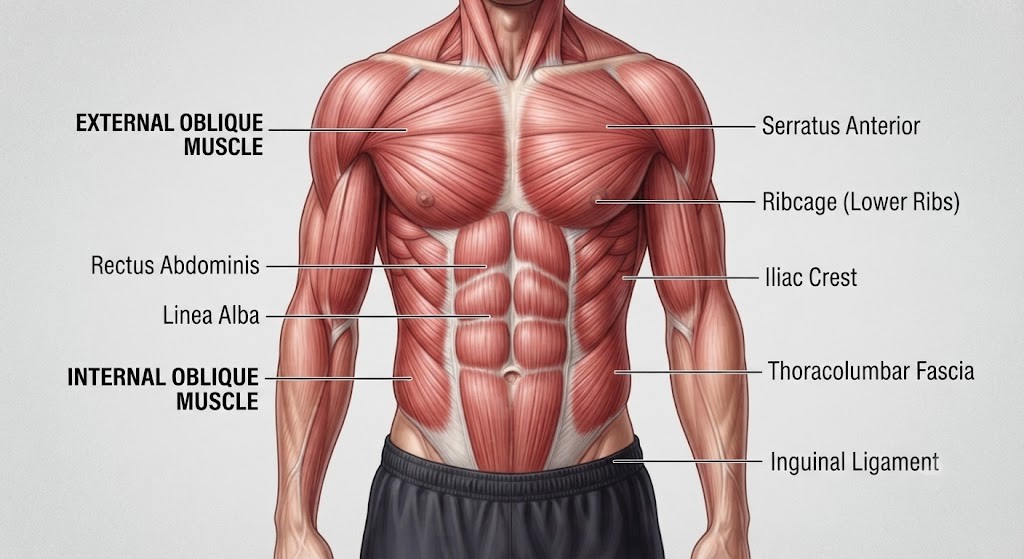
Internal vs. External Obliques
Your core contains two primary oblique muscle groups that work together during movement.
| Muscle | Location | Primary Function |
|---|---|---|
| External Oblique | Outer side of abdomen | Rotation, side bending, trunk stability |
| Internal Oblique | Under the external oblique | Supports rotation, posture, spinal stability |
These muscles activate during countless daily activities, including:
- Walking
- Running
- Carrying groceries
- Reaching overhead
- Twisting while driving
- Lifting heavy objects
- Playing sports
For example, when you turn your body to look behind you while reversing a car, both your internal and external obliques work together to produce controlled rotation.
After learning about the core muscles, you may also enjoy our complete core workout guide.
Why Should Beginners Train Their Oblique Muscles?
Oblique workouts are about much more than developing visible side abs. Strong oblique muscles improve the way your body moves, helping you stay stable during both exercise and daily activities.
Research published by the National Strength and Conditioning Association shows that a stronger core contributes to improved athletic performance and movement efficiency. — Source: NSCA, 2024.
Let’s look at the biggest benefits.
Better Posture
Poor posture often develops when the muscles supporting the spine become weak.
Strengthening your obliques helps maintain a neutral spine whether you’re sitting at a desk, standing in line, or walking throughout the day. For office workers and students who spend hours seated, improving oblique strength can reduce the effects of prolonged sitting.
Improved Balance
Every step you take requires your core muscles to stabilize your body.
Whether climbing stairs, performing lunges, or simply walking on uneven ground, stronger obliques improve coordination and help reduce unnecessary movement.
Lower Back Support
Weak obliques increase stress on the lumbar spine.
As these muscles become stronger, they share more of the workload with your back, helping improve spinal stability and reducing unnecessary strain while lifting, bending, or carrying objects.
According to the World Health Organization, low back pain remains one of the leading causes of disability worldwide. Regular strengthening exercises are recommended for prevention. — Source: WHO, 2023.
Better Sports Performance
Rotational strength is essential in many sports, including:
- Tennis
- Cricket
- Baseball
- Golf
- Swimming
- Boxing
Strong obliques help transfer force efficiently between your upper and lower body, improving both performance and movement control.
If your goal includes fat loss, pair these workouts with our body recomposition guide and calorie deficit diet plan.
Which Muscles Do Oblique Exercises Target?
Although oblique exercises emphasize the sides of your waist, they strengthen multiple muscles throughout your core.
External Oblique
The external oblique is the large muscle visible along the outer side of your abdomen.
Its primary functions include:
- Rotating the torso
- Side bending
- Maintaining posture
- Supporting heavy lifts
Internal Oblique
Located beneath the external oblique, the internal oblique stabilizes the pelvis and spine while assisting rotational movements.
Without sufficient strength here, twisting movements become less efficient and less stable.
Transverse Abdominis
Often referred to as your body’s natural weight belt, the transverse abdominis wraps around your midsection.
Although it isn’t technically an oblique muscle, it works continuously with the obliques to provide spinal stability and protect your lower back.
For example, during a side plank, all three muscles contract together to maintain proper alignment.
What Are the Best Oblique Exercises for Beginners at Home?
The best oblique workout for beginners uses simple bodyweight movements that prioritize stability and control before progressing to resistance training.
The only equipment you need is enough floor space and an exercise mat.
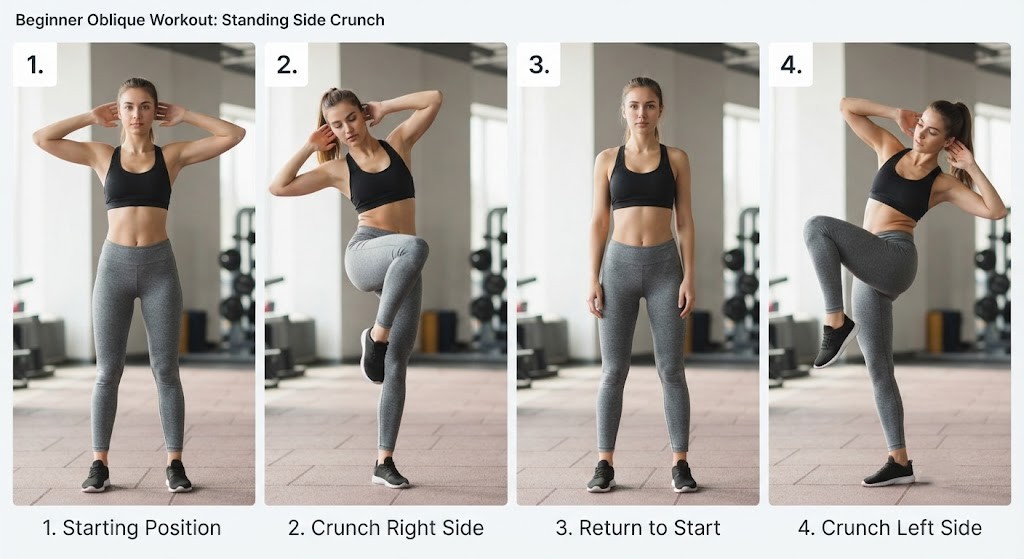
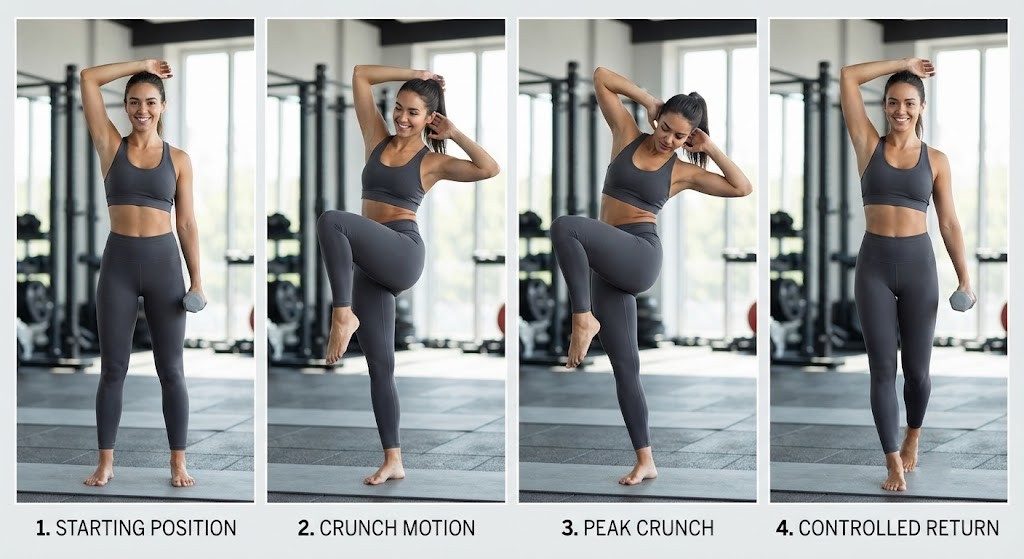
1. Standing Side Crunch
The standing side crunch is one of the easiest beginner exercises because it improves coordination while placing very little stress on the lower back.
How to Perform
- Stand with feet shoulder-width apart.
- Place both hands behind your head.
- Lift your right knee.
- Bring your right elbow toward the knee.
- Return slowly.
- Repeat on the opposite side.
Sets: 2–3
Reps: 12–15 each side
Benefits
- Improves balance
- Builds coordination
- Activates external obliques
- Beginner friendly
- No equipment required
2. Heel Touches
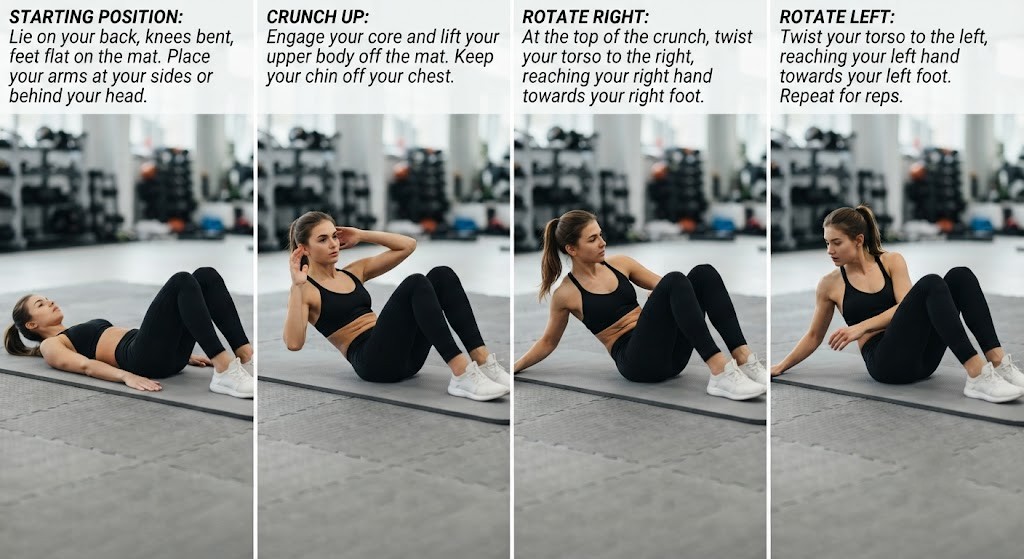
Heel touches isolate the side abdominal muscles while remaining simple enough for complete beginners.
Steps
- Lie on your back.
- Bend your knees.
- Keep your feet flat.
- Lift your shoulders slightly.
- Reach toward your right heel.
- Return.
- Repeat toward the left heel.
Sets: 3
Reps: 15–20 each side
Benefits
- Strengthens side abs
- Improves muscular endurance
- Minimal spinal stress
- Excellent home exercise
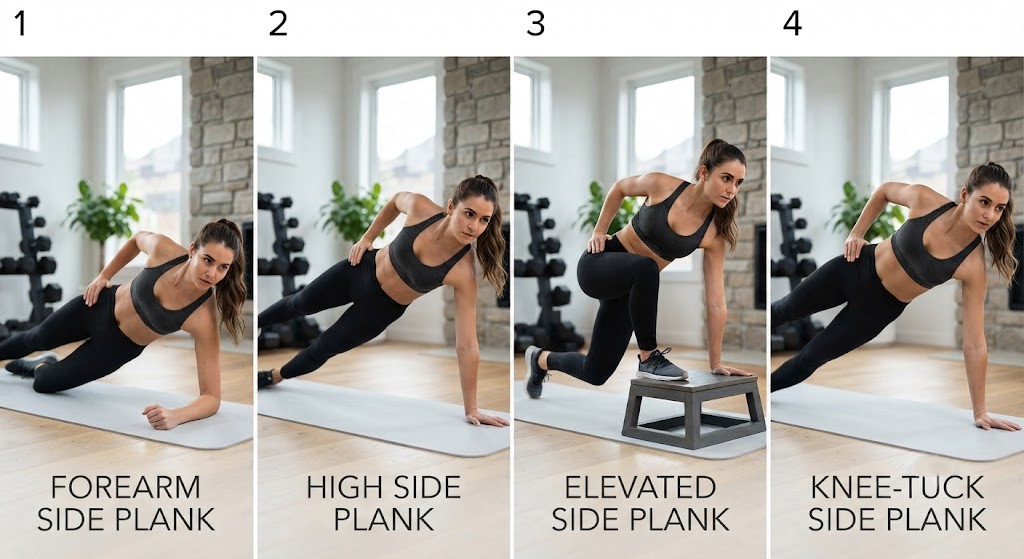
3. Modified Side Plank
The modified side plank develops stability without overwhelming beginners.
By performing it from your knees instead of your feet, maintaining correct alignment becomes much easier.
How to Perform
- Lie on one side.
- Bend both knees.
- Support yourself on your forearm.
- Lift your hips.
- Keep shoulders, hips, and knees aligned.
- Hold while breathing normally.
Hold: 20–30 seconds
Sets: 2–3 per side
Benefits
- Improves spinal stability
- Strengthens internal and external obliques
- Builds endurance
- Enhances posture
4. Russian Twist (Bodyweight)
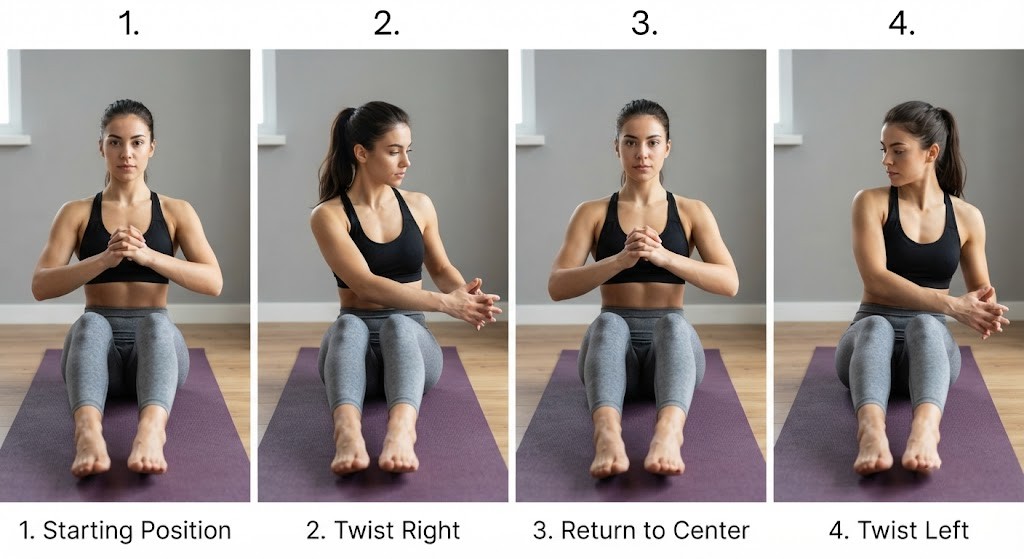
The bodyweight Russian twist develops rotational strength without requiring equipment.
Beginners should first master slow, controlled movements before adding weights.
How to Perform
- Sit with knees bent.
- Keep heels lightly touching the floor.
- Lean back about 45 degrees.
- Clasp your hands together.
- Rotate right.
- Return.
- Rotate left.
Sets: 2–3
Reps: 10–15 each side
Benefits
- Improves rotational strength
- Builds core endurance
- Enhances athletic performance
- Easy to perform anywhere
5. Bird Dog
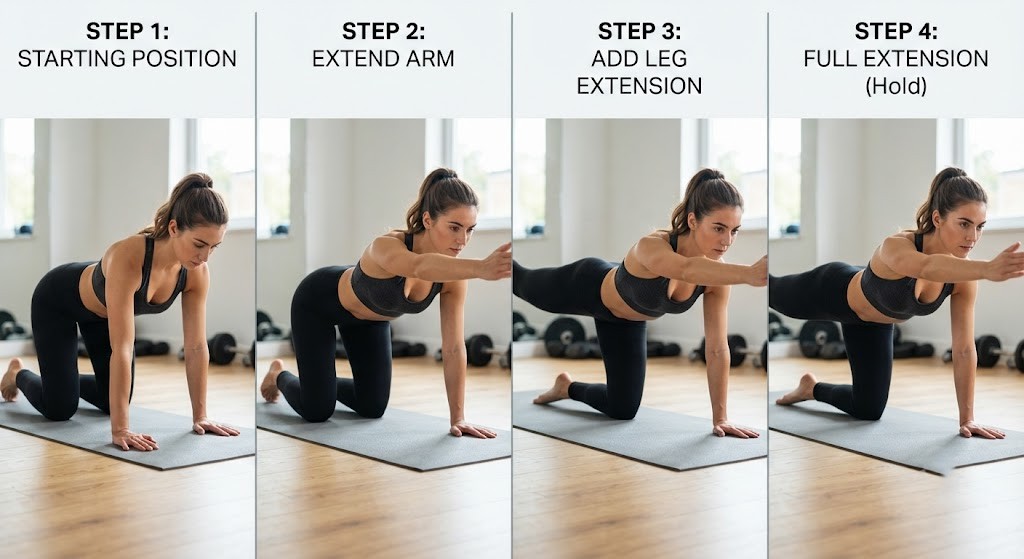
Bird dogs teach your body to resist unwanted rotation while improving balance and spinal control.
Steps
- Start on your hands and knees.
- Extend your right arm.
- Extend your left leg.
- Keep your hips level.
- Hold for two seconds.
- Return slowly.
- Switch sides.
Sets: 3
Reps: 10 each side
Benefits
- Improves posture
- Protects the lower back
- Builds coordination
- Strengthens deep core muscles
6. Dead Bug
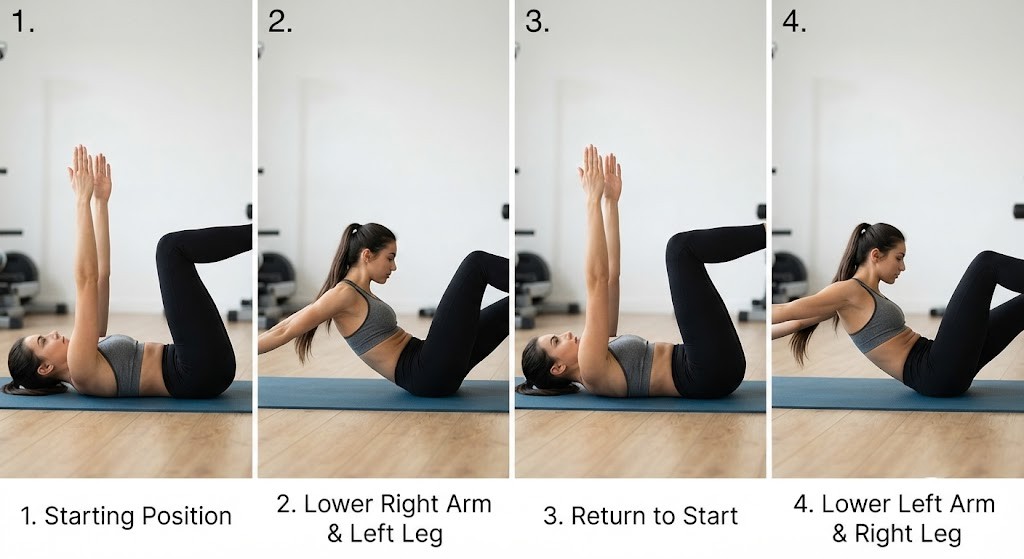
The dead bug strengthens the entire core while teaching proper spinal stability during movement.
Steps
- Lie on your back.
- Raise both arms.
- Bend knees to 90°.
- Lower your right arm and left leg.
- Return.
- Alternate sides.
Sets: 2–3
Reps: 10–12 each side
Benefits
- Improves coordination
- Strengthens deep abdominal muscles
- Supports spinal stability
- Beginner friendly
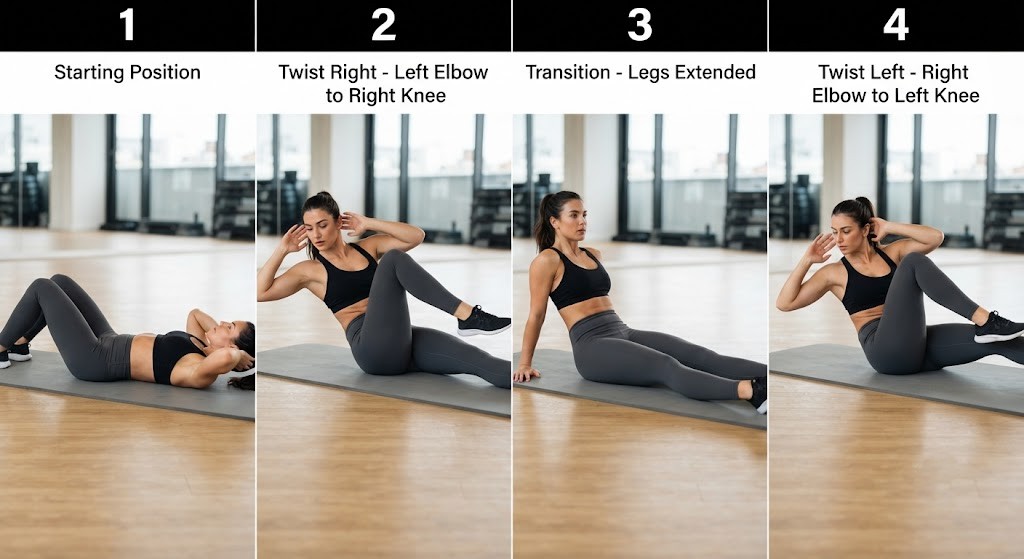
7. Bicycle Crunch
The bicycle crunch combines rotation with abdominal flexion, making it one of the most effective bodyweight exercises for the obliques.
Steps
- Lie on your back.
- Place hands behind your head.
- Lift shoulders.
- Bring right elbow toward left knee.
- Alternate sides slowly.
Sets: 3
Reps: 15–20
Benefits
- Activates upper abs
- Strengthens obliques
- Improves muscular endurance
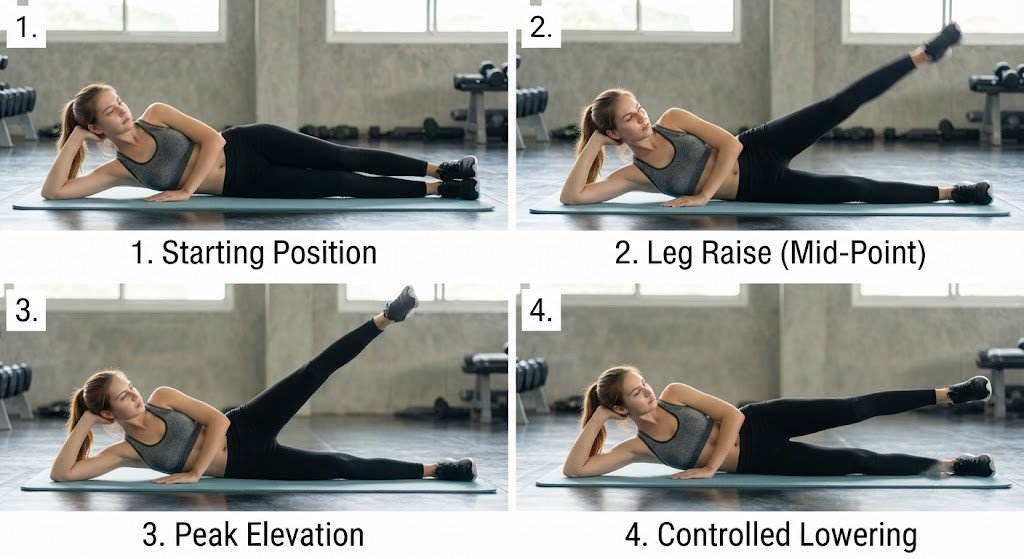
8. Side-Lying Leg Raise
This movement strengthens both your hip stabilizers and side core muscles simultaneously.
How to Perform
- Lie on one side.
- Keep legs straight.
- Lift the top leg.
- Lower slowly.
Sets: 2–3
Reps: 12–15
Benefits
- Improves hip stability
- Activates side core muscles
- Supports balance
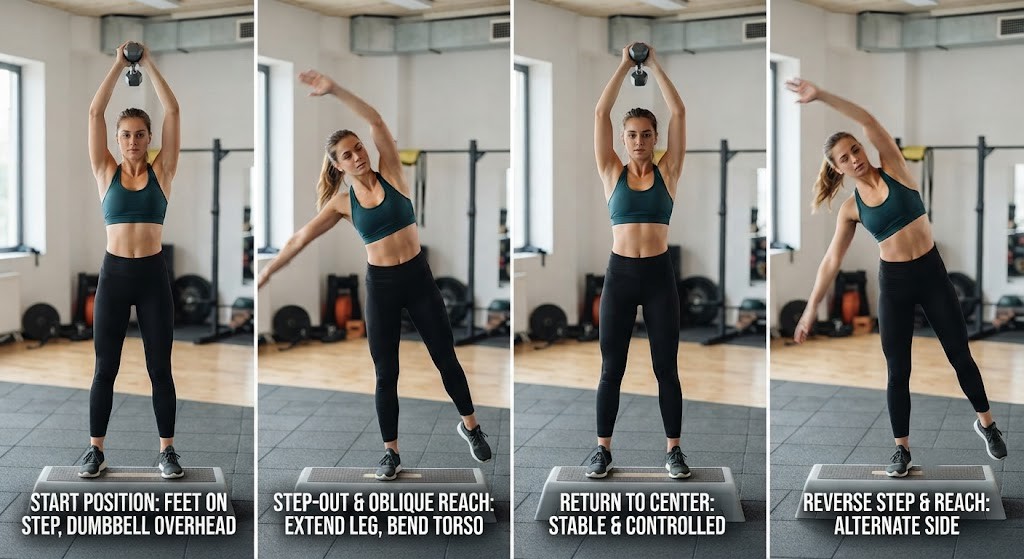
9. Standing Oblique Reach
This exercise combines mobility with gentle strengthening, making it an excellent cool-down or warm-up movement.
Steps
- Stand upright.
- Raise one arm overhead.
- Lean slowly to the opposite side.
- Return.
- Repeat.
Sets: 2
Reps: 15 each side
Benefits
- Improves mobility
- Builds core strength
- Reduces stiffness
- Beginner friendly
How Often Should Beginners Train Their Obliques?
Most beginners should perform an oblique workout for beginners two to three times each week.
Allow at least one recovery day between sessions because muscles grow stronger during rest—not while you’re exercising.
Weekly Beginner Schedule
| Day | Workout |
|---|---|
| Monday | Oblique Workout |
| Tuesday | Walking or Cardio |
| Wednesday | Full Body Strength |
| Thursday | Rest |
| Friday | Oblique Workout |
| Saturday | Beginner Leg Workout |
| Sunday | Recovery & Stretching |
For a balanced routine, combine this workout with our full body workout for beginners, beginner leg workout, and shoulder workout for beginners.
Beginner Oblique Workout Routine
A balanced routine should include mobility, stability, and strengthening exercises.
Warm-Up (5 Minutes)
- Arm circles
- Torso twists
- Cat-Cow stretch
- Hip circles
- March in place
Workout Plan
| Exercise | Sets | Reps |
|---|---|---|
| Standing Side Crunch | 3 | 15 |
| Heel Touches | 3 | 20 |
| Modified Side Plank | 3 | 30 sec |
| Russian Twist | 3 | 15 |
| Bird Dog | 3 | 10 |
| Dead Bug | 3 | 12 |
| Bicycle Crunch | 3 | 20 |
| Standing Oblique Reach | 2 | 15 |
Rest for 30–60 seconds between exercises.
Finish with our post workout stretching routine to improve recovery.
Can Oblique Workouts Help Improve Posture and Balance?
Yes. Oblique workouts strengthen the muscles responsible for stabilizing your spine and pelvis.
As these muscles become stronger, your body maintains better alignment during walking, standing, lifting, and other daily activities. Better core stability also improves movement efficiency and reduces unnecessary stress on surrounding muscles.
According to the American College of Sports Medicine, regular core training improves balance, movement efficiency, and functional fitness. — Source: ACSM, 2024.
Do Oblique Workouts Burn Belly Fat or Love Handles?
No exercise can target fat loss in a single area of the body.
An oblique workout for beginners strengthens the muscles underneath your love handles, but reducing body fat requires a consistent calorie deficit and regular physical activity.
For best results:
- Eat sufficient protein
- Strength train consistently
- Walk daily
- Sleep 7–9 hours
- Stay hydrated
Pair your workouts with our calorie deficit diet plan for sustainable fat loss.
What Mistakes Should Beginners Avoid During Oblique Exercises?
Avoiding common mistakes improves results while reducing injury risk.
Common Errors
- Using momentum instead of muscle control
- Twisting too quickly
- Holding your breath
- Arching the lower back
- Skipping warm-ups
- Training every day
- Ignoring recovery
- Sacrificing form for extra repetitions
A slower tempo usually leads to better muscle activation. You can also learn more about controlled training in our time under tension workout.
What Equipment Is Helpful for Beginner Oblique Training?
Bodyweight training is enough for most beginners, but adding simple equipment later can increase workout variety and progression.
Useful equipment includes:
- Exercise mat
- Resistance bands
- Light dumbbells
- Stability ball
- Cable machine (gym)
- Medicine ball
Home alternatives include:
- Water bottles
- Backpacks filled with books
- Resistance loops
How Can Beginners Progress to More Advanced Oblique Exercises?
Once you’ve mastered the fundamentals, gradually increase the challenge using progressive overload.
Effective progression methods include:
- Adding resistance bands
- Using dumbbells
- Holding side planks longer
- Increasing repetitions gradually
- Reducing rest periods
- Performing cable wood chops
- Trying advanced plank variations
Combine these progressions with our back workout for beginners and yoga for core strength to continue building strength safely.
Conclusion
An oblique workout for beginners is one of the most effective ways to build a stronger, healthier, and more functional core. Rather than relying solely on crunches, training your obliques improves posture, balance, spinal stability, coordination, and rotational strength that benefits both everyday activities and athletic performance.
Start with beginner-friendly exercises such as standing side crunches, heel touches, modified side planks, bird dogs, and Russian twists. Focus on proper technique, controlled movement, and consistent practice instead of rushing to add resistance. By training your obliques two or three times per week and combining these workouts with full-body strength training, balanced nutrition, and adequate recovery, you’ll build a resilient core that supports long-term fitness and overall health.
FAQs
What are oblique workouts good for?
They improve core strength, posture, balance, spinal stability, and rotational movement.
How often should beginners train their obliques?
Train your obliques 2–3 times per week with at least one rest day between sessions.
Can beginners do oblique exercises every day?
No. Rest days help your muscles recover and grow stronger.
Do oblique workouts reduce love handles?
No. They strengthen the muscles, but reducing love handles requires overall body fat loss.
What is the easiest oblique exercise for beginners?
Standing side crunches and heel touches are the easiest beginner-friendly exercises.
Do I need equipment for an oblique workout?
No. Most beginner oblique exercises only require your body weight.
How long does it take to strengthen your obliques?
Most beginners notice improved strength and stability within 4–8 weeks of consistent training.
Are oblique workouts safe for people with lower back pain?
Yes, if performed with proper form. Consult a healthcare professional if you have existing back pain.
What is the best oblique exercise?
The modified side plank is one of the best exercises for building oblique strength and stability.
Do obliques give you a V-line?
They help define your waist, but a visible V-line mainly depends on having low body fat.
What is the No. 1 exercise for abs?
The plank is one of the best overall exercises because it strengthens the entire core.
What is oblique work?
Oblique work refers to exercises that strengthen the muscles on the sides of your abdomen for better stability and rotation.