
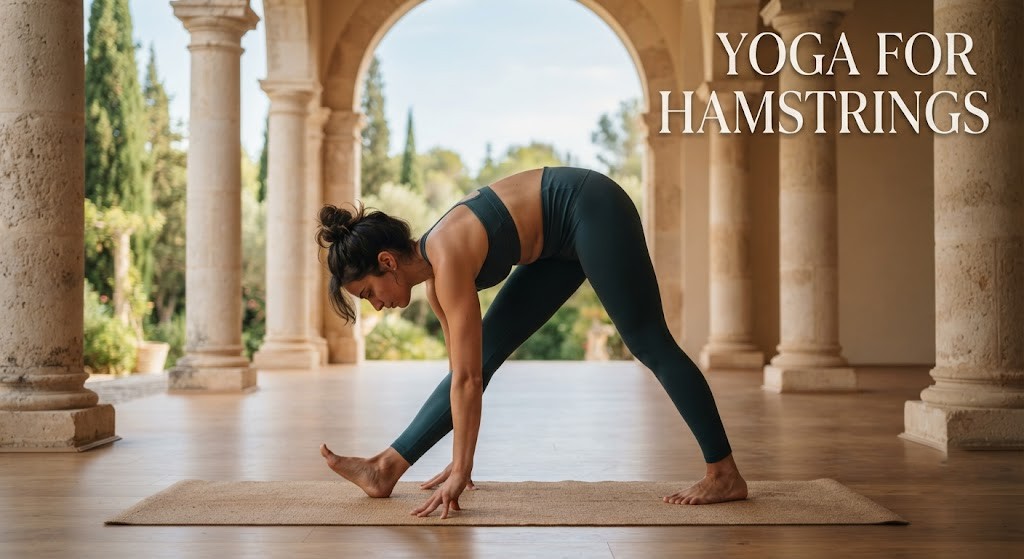
If your hamstrings always feel tight during forward folds, workouts, running, or everyday movement, you have probably already tried stretching them. The challenge is often not simply stretching more, but knowing which yoga poses to use, how long to hold them, and how to modify them without forcing your range of motion.
Yoga for hamstrings combines controlled movement, breathing, flexibility work, and mobility exercises to help you gradually explore a more comfortable range of motion. Whether you are a beginner, runner, strength-training enthusiast, or someone who spends long hours sitting, the right hamstring-focused yoga routine can become a practical part of your mobility practice.
In this guide, you will learn the best yoga poses for hamstrings, how to stretch tight hamstrings safely, how long to hold each pose, beginner modifications, and a simple 10–15 minute routine you can practice regularly.
What Is Yoga for Hamstrings and How Does It Work?
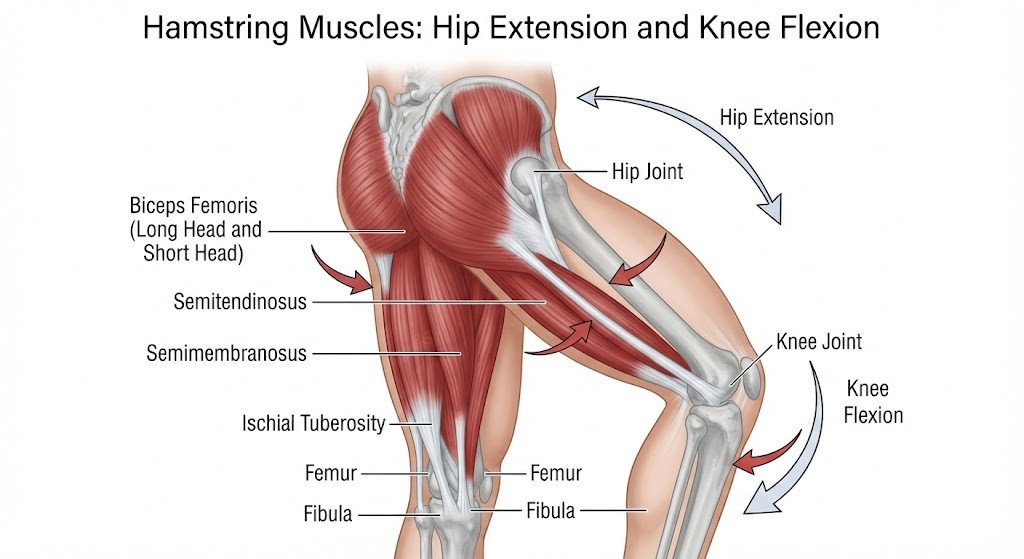
Hamstring-focused yoga is a form of flexibility and mobility practice that uses controlled yoga poses to stretch and move the muscles at the back of the thighs. The hamstrings include three primary muscles—the biceps femoris, semitendinosus, and semimembranosus—which help extend the hip and bend the knee.
Unlike simply trying to touch your toes, hamstring yoga combines hip movement, knee position, breathing, and controlled range of motion. For example, a strap-supported Reclining Hand-to-Big-Toe Pose can create a useful stretch without requiring you to force your leg toward your head.
It is also important to distinguish flexibility from strength. Flexibility describes how much range of motion is available, while strength describes your ability to produce force and control movement. Therefore, even flexible hamstrings can benefit from appropriate strengthening and movement practice.
Why Are My Hamstrings Tight During Yoga?
Hamstrings can feel tight during yoga because of limited flexibility, prolonged sitting, training demands, unfamiliar movement, or individual differences in anatomy and mobility. For example, someone who sits for several hours each day may notice more restriction during a forward fold than during ordinary walking.
However, the sensation you interpret as tightness does not necessarily mean the muscle is physically shortened. Your nervous system, joint position, hip mobility, and movement habits can all influence how a stretch feels.
For this reason, a comfortable and controlled range of motion is more useful than trying to reach a specific flexibility benchmark.
Why Does Yoga for Hamstrings Matter?
Yoga for hamstrings matters because consistent flexibility and mobility work can support range of motion and comfortable movement. Regular hamstring stretching may make movements such as bending forward, lifting the leg, or performing certain yoga positions feel easier over time.
Research supports stretching as a method for improving hamstring range of motion, although studies have used different techniques and protocols. A systematic review of 28 studies involving 1,338 healthy participants found improvements in range of motion across the included hamstring stretching studies, while noting that study quality varied — Source: Decoster et al., 2005.
Similarly, a meta-analysis of 19 studies found that static stretching improved several measures of hamstring flexibility in healthy young adults compared with control conditions — Source: Medeiros et al., 2016.
In addition, a 2024 systematic review and meta-analysis found stretching interventions were more effective than no intervention for improving hamstring flexibility in university students with hamstring tightness, although the certainty of some comparisons was low — Source: PubMed, 2024.
For broader lower-body mobility, explore our 15 Minute Daily Yoga Routine.
What Are the Best Yoga Poses for Hamstring Flexibility?
The best yoga poses for hamstring flexibility are controlled positions that allow you to gradually explore your available range without pain. Standing Forward Fold, Half Splits, Seated Forward Fold, and Reclining Hand-to-Big-Toe Pose are particularly useful options.
1. Standing Forward Fold
Standing Forward Fold stretches the posterior chain while allowing you to control the depth of the movement.
- Stand with your feet about hip-width apart.
- Soften your knees slightly.
- Hinge forward from your hips.
- Let your hands rest on the floor, blocks, or your legs.
- Keep your breathing slow and relaxed.
Hold for 20–40 seconds, repeating 1–2 times.
For beginners, bend your knees more or place your hands on yoga blocks. Avoid pulling your torso toward your legs simply to reach the floor.
2. Downward-Facing Dog
Downward-Facing Dog combines hamstring stretching with calf, hip, shoulder, and spinal movement. Start on your hands and knees, lift your hips upward, and gradually straighten your legs without forcing them completely straight.
Beginners can alternate bending one knee while extending the opposite leg to explore the posterior chain dynamically.
Hold for 20–45 seconds with comfortable breathing.
3. Half Splits
Half Splits target the hamstrings of the extended leg while allowing beginners to control the range easily.
From a low lunge, shift your hips backward and straighten the front leg as comfortably as possible. Keep your spine long rather than collapsing toward the floor.
Place your hands on blocks if reaching the floor causes excessive rounding.
Hold for 20–40 seconds per side.
4. Seated Forward Fold
Seated Forward Fold stretches the hamstrings while keeping the legs extended in front of you. Sit tall with your legs extended, inhale to lengthen your spine, then hinge forward from your hips.
A strap around your feet can help you maintain a long spine without pulling aggressively.
Hold for 20–45 seconds.
5. Head-to-Knee Pose
Head-to-Knee Pose combines hamstring stretching with a single-leg setup that can be easier to manage than a two-leg forward fold. Extend one leg while bending the opposite knee, then hinge toward the extended leg.
Use a folded blanket beneath your hips if sitting upright feels difficult.
Hold for 20–40 seconds per side.
6. Reclining Hand-to-Big-Toe Pose
Reclining Hand-to-Big-Toe Pose provides a supported hamstring stretch while you lie on your back. Extend one leg upward and use a yoga strap around the foot instead of forcing yourself to hold the toes.
Keep your opposite leg relaxed and your hips relatively stable.
Hold for 20–45 seconds per side.
7. Pyramid Pose
Pyramid Pose combines a standing position with a forward hinge to create a focused hamstring stretch. Step one foot forward, keep both legs controlled, and hinge toward the front leg.
Place blocks on either side of the front foot to reduce the need to reach the floor.
Hold for 20–40 seconds per side.
8. Wide-Legged Forward Fold
Wide-Legged Forward Fold uses a wider stance to stretch both legs while giving you several hand-placement options. Stand with your feet comfortably apart, hinge from the hips, and lower your hands toward the floor or blocks.
Avoid forcing your legs wider than your comfortable range.
9. Low Lunge
Low Lunge supports hamstring mobility by combining hip extension on one side with controlled movement through the opposite leg. Start with one foot forward and one knee behind you, then adjust your front-leg position according to comfort.
For a deeper hamstring emphasis, gradually shift your hips backward into Half Splits.
| Yoga pose | Main focus | Beginner modification | Suggested hold |
|---|---|---|---|
| Standing Forward Fold | Hamstrings/posterior chain | Bend knees | 20–40 sec |
| Downward-Facing Dog | Hamstrings + calves | Bend knees | 20–45 sec |
| Half Splits | Front-leg hamstring | Use blocks | 20–40 sec/side |
| Seated Forward Fold | Hamstrings | Use strap | 20–45 sec |
| Head-to-Knee Pose | One hamstring at a time | Sit on blanket | 20–40 sec/side |
| Reclining Hand-to-Big-Toe | Hamstring isolation | Use strap | 20–45 sec/side |
| Pyramid Pose | Hamstring + hip mobility | Use blocks | 20–40 sec/side |
How Do You Stretch Tight Hamstrings With Yoga?
You stretch tight hamstrings with yoga by gradually entering a comfortable range, breathing steadily, and avoiding forceful or painful movement. Instead of pulling your chest toward your thighs during a forward fold, maintain a long spine and stop when the stretch becomes clearly noticeable but manageable.
1. Warm Up First
Before deeper static stretches, use gentle movements such as walking, leg swings, controlled lunges, or dynamic mobility. These movements can prepare the body for a larger range of motion.
2. Keep Breathing
Hamstring yoga involves gradually moving into comfortable positions, maintaining controlled breathing, and avoiding forceful or painful stretching. Holding your breath can make the practice feel unnecessarily tense.
3. Avoid Bouncing
A controlled stretch allows you to monitor your range of motion and reduce unnecessary force. Move smoothly into and out of each position rather than repeatedly bouncing at the end of your range.
4. Learn the Difference Between Stretching and Pain
A mild pulling or tension sensation can be normal, while sharp pain, numbness, tingling, or sudden discomfort is a reason to stop.
A 2023 meta-analysis of 27 randomized controlled trials involving 606 participants found that dynamic and static stretching produced broadly similar acute effects on hamstring range of motion, while repeated static stretching showed advantages in some longer-term comparisons — Source: PubMed, 2023.
For additional mobility work, see our mobility exercises guide.
What Is the Best Beginner Yoga Routine for Hamstrings?
A beginner hamstring yoga routine should use gentle positions, short holds, and gradual progression rather than maximum stretching intensity. The following 10–15 minute sequence works well as a general flexibility session.
10–15 Minute Hamstring Yoga Sequence
1. Gentle warm-up — 2 minutes
Start with easy walking in place, hip movements, and controlled leg swings. Keep the movements comfortable and avoid aggressive ballistic stretching.
2. Downward-Facing Dog — 45 seconds
Bend your knees as needed and alternate gentle knee bends.
3. Low Lunge — 30 seconds per side
Keep your hands on blocks if reaching the floor feels uncomfortable.
4. Half Splits — 30 seconds per side
Shift backward gradually while maintaining control of the front leg.
5. Standing Forward Fold — 45 seconds
Keep your knees slightly bent if your hamstrings feel particularly tight.
6. Seated Forward Fold — 45 seconds
Use a strap and focus on hinging from your hips.
7. Reclining Hand-to-Big-Toe Pose — 30 seconds per side
Use a strap to control the leg position.
8. Relaxation — 1–2 minutes
Lie comfortably and allow your breathing to return to normal.
By using this sequence 3–5 times per week, you can create a sustainable flexibility habit while allowing your body time to adapt.
A 2026 dose-response meta-analysis included 84 studies with 4,067 participants and found that repeated stretching programs were more likely to produce meaningful range-of-motion improvements than very brief single-session exposure — Source: Mendez-Rebolledo et al., 2026.
How Long Should You Hold a Hamstring Yoga Pose?
Most beginners can start with approximately 20–45 seconds for a comfortable static hamstring pose. For example, holding Half Splits for 30 seconds per side provides enough time to explore the position without requiring a long session.
However, there is no single universally optimal hold time for every person. Research on hamstring stretching has used different durations, techniques, and frequencies, making it difficult to identify one perfect prescription — Source: Decoster et al., 2005.
Moreover, a 2024 systematic review of static stretching involving 189 studies and 6,654 adults found positive acute and chronic effects on flexibility, with the authors identifying different cumulative volumes associated with flexibility improvements — Source: PubMed, 2024.
For beginners, consistency and controlled technique matter more than chasing an extremely long hold.
Can Yoga Improve Hamstring Flexibility?
Yoga can contribute to improved hamstring flexibility because many yoga poses provide repeated, controlled exposure to a larger range of motion. For example, practicing Half Splits and Reclining Hand-to-Big-Toe Pose regularly can gradually make those positions more comfortable.
Static stretching research provides supporting evidence that repeated stretching can improve hamstring range of motion, although the studies do not specifically prove that every yoga sequence produces the same effect — Source: Medeiros et al., 2016.
Importantly, flexibility gains are individual. Your progress depends on factors such as starting mobility, training history, anatomy, consistency, recovery, and technique.
Yoga should therefore be viewed as one component of a broader movement program rather than a guaranteed solution for every cause of hamstring tightness.
Should You Stretch Your Hamstrings Before or After a Workout?
Gentle dynamic mobility is generally more appropriate before many workouts, while longer static stretching can fit more naturally into a separate flexibility or post-workout session. For example, a runner might use controlled leg swings and walking lunges during a warm-up, then perform Half Splits after training.
For Runners
Runners can use hamstring-focused yoga to complement mobility and recovery work. A short routine may include Downward-Facing Dog, Low Lunge, Half Splits, and Reclining Hand-to-Big-Toe Pose.
After Strength Training
Post-workout yoga can provide a low-intensity way to work on flexibility after strength training. Keep the intensity moderate rather than forcing a deep stretch when the muscles are already fatigued.
post-workout stretching routine
For Cyclists and People Who Sit
Cyclists and people who sit for long periods can combine hamstring work with hip and calf mobility. A broader routine can include Low Lunge, Half Splits.
How Can Beginners Modify Hamstring Yoga Poses?
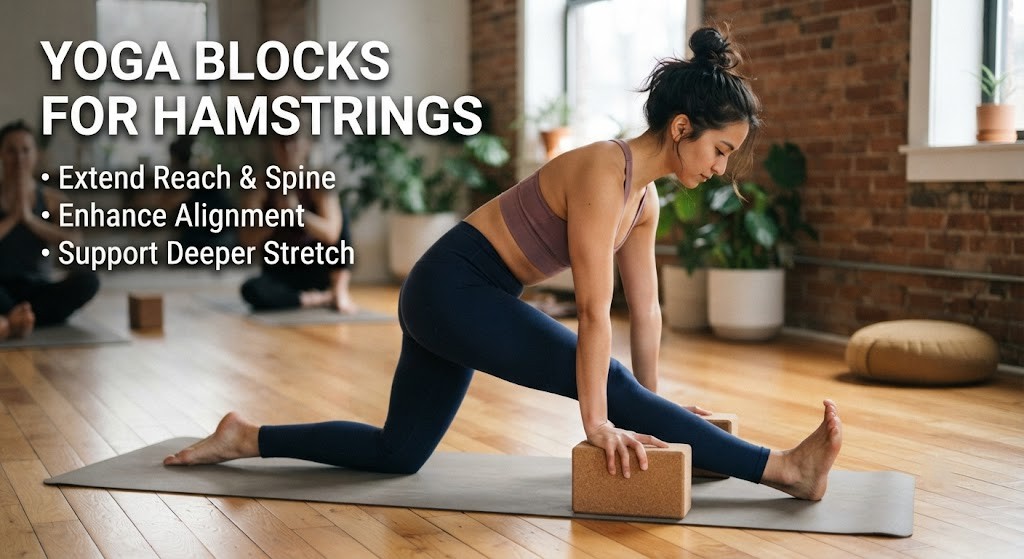
Beginners can modify hamstring yoga poses by using props that reduce the need to reach deeply into a position. For example, placing two blocks beneath your hands during Pyramid Pose can let you maintain better alignment without forcing your spine toward the floor.
Useful modifications include:
- Yoga blocks: Bring the floor closer to your hands.
- Yoga straps: Extend your reach in seated or reclining poses.
- Blankets: Raise the hips during seated poses.
- Chair: Provide support during standing forward folds.
- Wall: Improve balance during standing stretches.
- Bent knees: Reduce the intensity of many hamstring positions.
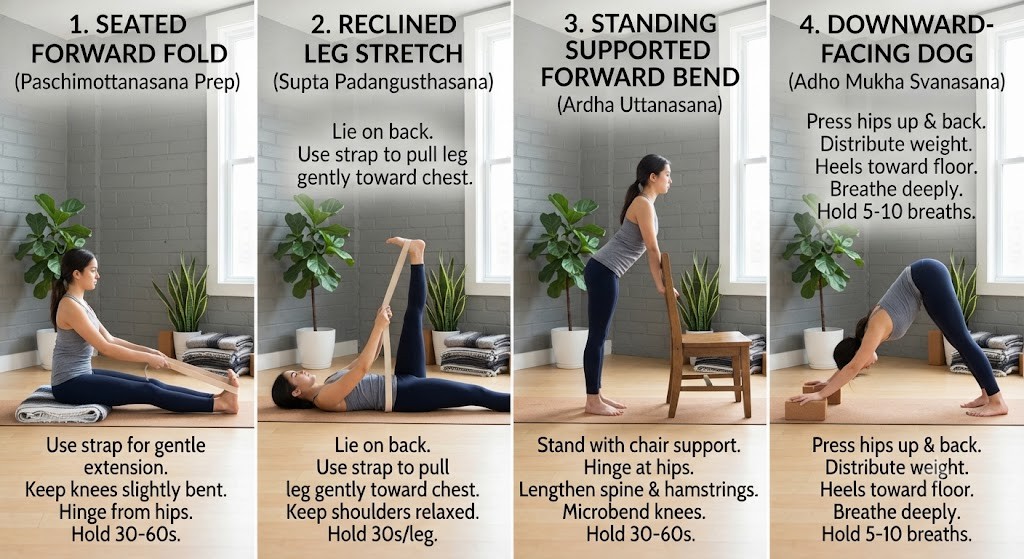
Yoga props such as straps, blocks, blankets, and chairs can modify hamstring poses by reducing the need to reach deeply into a stretch.
What Should You Do If Hamstring Stretching Hurts?
You should stop or modify a hamstring stretch if it causes sharp pain, sudden discomfort, numbness, or tingling. For example, if a forward fold produces a sudden pulling sensation behind the knee rather than a manageable stretch through the thigh, reduce the range or stop.
Furthermore, people recovering from a hamstring strain should not use aggressive stretching as a replacement for individualized rehabilitation. Research shows that strength and flexibility deficits can persist after hamstring injuries, meaning recovery requires more than simply increasing passive flexibility — Source: Maniar et al., 2016.
If symptoms are persistent, severe, or associated with an injury, consult an appropriately qualified healthcare professional.
What Tools Make Hamstring Yoga Easier?
Yoga props make hamstring yoga more accessible by changing leverage and support rather than forcing additional range of motion. For example, a strap lets you hold a raised leg without rounding your back to reach the foot.
A simple setup can include:
- A non-slip yoga mat for stability.
- Two yoga blocks for standing poses.
- A strap for seated and reclining stretches.
- A folded blanket for seated support.
- A sturdy chair for balance and modifications.
The goal is not to use more equipment. The goal is to make good technique easier while keeping the stretch controlled.
How Often Should You Do Yoga for Tight Hamstrings?
You can practice gentle hamstring yoga several times per week as long as your body tolerates the workload and you allow adequate recovery. For example, a beginner might start with 10–15 minutes three days per week and gradually increase frequency if the practice remains comfortable.
Track progress through practical measures rather than forcing deeper positions. You might record how comfortably you can perform a forward fold, how easily you can straighten your leg in Reclining Hand-to-Big-Toe Pose, or whether everyday movements feel less restricted.
Yoga for flexibility exercises
Moreover, flexibility improvements are often gradual. A 2026 meta-analysis found that repeated stretching over at least one week was more likely to produce meaningful ROM changes than a very brief single exposure, although the optimal dose varied by stretching method and population — Source: Mendez-Rebolledo et al., 2026.
What’s Next: How Can You Build Better Hamstring Mobility?
The next step is to build a consistent hamstring mobility routine that combines controlled stretching with strength and full-body movement. For example, you could perform the 10–15 minute sequence three times weekly and add lower-body strengthening on separate or complementary days.
Start With a Manageable Routine
Choose four to six poses that feel useful rather than attempting every stretch in one session. A smaller routine is often easier to perform consistently.
Establish a Starting Point
Record your starting range using a simple movement such as a comfortable forward fold. This gives you a practical reference for noticing changes over time.
Repeat Before Changing Everything
Repeat the same routine for several weeks before judging your progress. Consistency makes it easier to determine whether your practice is producing useful changes.
Progress Gradually
Gradually adjust the range, duration, or exercise selection instead of forcing deeper positions. Progress does not require turning every session into a maximum stretch.
Conclusion
Yoga for hamstrings is most useful when practiced consistently, comfortably, and with controlled movement. Standing Forward Fold, Half Splits, Downward-Facing Dog, Seated Forward Fold, and Reclining Hand-to-Big-Toe Pose provide several ways to work on hamstring flexibility at different experience levels.
You do not need to force your body into advanced positions to make progress. A manageable stretch, steady breathing, appropriate modifications, and regular practice provide a more sustainable approach than aggressive stretching.
Finally, remember that flexibility is only one part of lower-body function. Combine yoga with strength, mobility, recovery, and appropriate professional guidance when an injury or persistent pain is involved.
FAQs
What is the best yoga pose for tight hamstrings?
Standing Forward Fold, Half Splits, and Downward-Facing Dog are useful options.
How long should you hold a hamstring yoga pose?
Hold each pose for about 20–45 seconds for a comfortable stretch.
Can yoga loosen tight hamstrings?
Yes, regular yoga can gradually improve hamstring flexibility.
How often should I do yoga for tight hamstrings?
Practice for 10–15 minutes about three times per week.
Is Downward-Facing Dog good for hamstrings?
Yes, it gently stretches the hamstrings and calves.
Should I bend my knees when my hamstrings are tight?
Yes, slightly bending your knees can make the stretch more comfortable.
Can beginners do hamstring yoga?
Yes, beginners can use props and shorter holds to modify poses.
What is the fastest way to fix tight hamstrings?
Consistent stretching, mobility exercises, and strengthening can gradually reduce tightness.
What is the root cause of tight hamstrings?
Sitting, limited mobility, training demands, and movement habits can contribute to tightness.
What are the spiritual reasons for tight hamstrings?
Some traditions link tight hamstrings with emotional tension, but this is not medically established.
What can be mistaken for tight hamstrings?
Nerve irritation, hip problems, lower-back issues, or muscle strains can cause similar sensations.
Can yoga prevent hamstring injuries?
Yoga can support mobility but does not guarantee injury prevention.
What props are useful for hamstring yoga?
Blocks, straps, blankets, and chairs can make hamstring poses easier.