You may already know that yoga can improve flexibility, mobility, balance, and body awareness—but not every yoga style approaches movement in the same way. Iyengar Yoga for beginners places particular emphasis on alignment, precision, sequencing, controlled practice, and supportive props.
Instead of rushing from one posture to another, Iyengar Yoga encourages you to understand how a pose is performed and how your body responds to it. This makes it an interesting approach for beginners who want to develop a strong foundation rather than simply chase advanced poses or greater flexibility.
In this guide, you’ll learn what Iyengar Yoga is, how it differs from other styles, which beginner poses to try, how props work, how to practice safely at home, and how to build a simple beginner-friendly routine.
What Is Iyengar Yoga and How Does It Work?
Iyengar Yoga is a style of yoga that emphasizes precise alignment, controlled movement, sequencing, and the use of props to support an individual’s practice. The method was developed by B.K.S. Iyengar, who taught for more than 70 years and became especially known for his detailed approach to asana practice.
Rather than simply moving from one pose to another, Iyengar Yoga focuses on how you perform each posture. For example, when practicing Tadasana, a beginner may learn how to position the feet, legs, pelvis, spine, shoulders, and head with careful attention rather than simply standing upright.
The method incorporates several important elements:
- Alignment — organizing the body appropriately within a posture.
- Precision — paying attention to specific actions and details.
- Sequencing — practicing postures in an intentional order.
- Timing — remaining in poses long enough to observe and refine them.
- Observation — developing greater awareness of physical and mental responses.
- Props — using supportive tools to make poses more accessible and stable.
Iyengar Yoga UK describes alignment, precision, sequencing, timing, and props as central characteristics of an Iyengar class.
How Is Iyengar Yoga Different From Other Yoga Styles?
Iyengar Yoga differs from faster-flowing yoga styles because it generally gives more attention to detailed alignment, sustained poses, and systematic progression. Instead of quickly linking several standing poses, a teacher may spend several minutes helping students refine one posture.
At the same time, Iyengar Yoga does not require advanced flexibility before you begin. The method starts with foundational postures and progressively develops skill, making it suitable for people who are new to yoga or returning after a long break.
| Feature | Iyengar Yoga | Faster Flow Styles |
|---|---|---|
| Main focus | Alignment and precision | Movement and flow |
| Pace | Deliberate and controlled | Often faster |
| Props | Frequently used | Varies |
| Beginner approach | Progressive and structured | Varies by class |
| Pose duration | Often sustained | Often shorter |
| Instruction | Detailed | Varies |
Why Is Iyengar Yoga Good for Beginners?
Iyengar Yoga is good for beginners because its structured instruction, careful alignment, and adaptable use of props can make foundational postures easier to understand and practice.
Iyengar Yoga for beginners focuses on learning foundational postures with careful attention to alignment rather than achieving advanced poses or maximum flexibility. This approach can help new practitioners become more aware of their bodies while developing basic movement skills.
Yoga research also supports potential benefits for physical function. A systematic review of 22 randomized controlled trials involving older adults found significant improvements in balance, lower-body flexibility, and lower-limb strength compared with inactive controls.
Source: BMC Sports Science, Medicine and Rehabilitation, 2019.
A 2023 systematic review of 15 studies also found that yoga was associated with improvements in balance, flexibility, muscle strength, and depressive symptoms among older adults.
Source: Frontiers in Aging Neuroscience, 2023.
What Benefits Can Beginners Expect?
Potential Iyengar Yoga benefits may include improvements in:
- Mobility
- Balance
- Strength
- Posture awareness
- Concentration
- Body awareness
- Confidence in movement
For example, a beginner who initially struggles to maintain a standing posture may gradually develop better leg stability and awareness through repeated practice.
Similarly, a randomized controlled trial involving 72 distressed women found significant improvements in perceived stress and several psychological outcomes after three months of Iyengar Yoga practice.
Source: Evidence-Based Complementary and Alternative Medicine, 2012.
For more mobility-focused ideas, explore our yoga for flexibility. Beginners interested in alignment can also explore yoga for posture.
What Are the Main Principles of Iyengar Yoga?
The main principles of Iyengar Yoga are alignment, precision, sequencing, duration, observation, and appropriate use of props. Together, these principles make each posture more intentional and help students understand the actions involved.
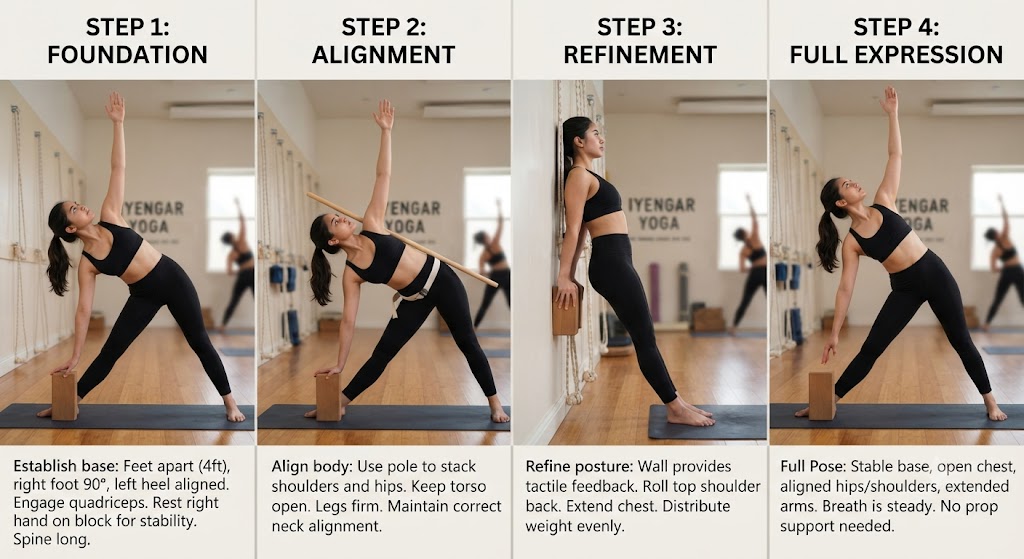
First, alignment refers to organizing the body appropriately within a posture. For example, in Trikonasana, you may work on the relationship between your feet, legs, pelvis, spine, arms, and head rather than simply trying to reach the floor.
Second, precision means paying attention to specific actions within the pose. Third, sequencing means arranging postures in an intentional order so that one movement prepares the body and mind for another.
Why Does Alignment Matter in Iyengar Yoga?
Alignment matters because it helps beginners understand the actions required within each posture rather than chasing a particular visual shape.
For example, placing a hand on a block in Trikonasana can allow you to maintain a more organized torso without forcing your hand toward the floor.
Iyengar Yoga alignment is about appropriate positioning and awareness, not perfection. Your ideal position may look different from another person’s because mobility, proportions, experience, and physical needs vary.
How Does Sequencing and Timing Work?
Sequencing refers to the deliberate order in which postures are practiced, while timing refers to how long a posture is maintained.
For example, a beginner class may use standing poses before seated or restorative work to gradually prepare the body. Longer holds can also give you an opportunity to observe breathing, muscular effort, balance, and alignment.
However, longer holds should not be interpreted as a requirement to tolerate pain or extreme discomfort. The purpose is observation and refinement—not simply enduring a position.
Which Iyengar Yoga Poses Are Best for Beginners?
The best Iyengar Yoga poses for beginners are foundational postures that develop body awareness, stability, mobility, and alignment without requiring advanced flexibility.
Beginner Iyengar Yoga focuses on foundational postures rather than advanced poses or extreme flexibility.
Useful beginner options include:
- Tadasana (Mountain Pose) — develops standing awareness and posture.
- Uttanasana (Standing Forward Bend) — introduces forward bending with appropriate modification.
- Trikonasana (Triangle Pose) — develops standing strength and lateral extension.
- Virabhadrasana II (Warrior II) — builds leg strength and awareness.
- Dandasana (Staff Pose) — teaches seated alignment.
- Setu Bandha Sarvangasana (Bridge Pose) — introduces supported back-body work.
- Supported restorative poses — encourage relaxation and accessible positioning.
For a broader introduction, see our Full Body Yoga.
How Should Beginners Practice Tadasana?
Tadasana is a foundational standing pose in which you learn to organize the body while standing steadily.
Begin with your feet comfortably positioned and distribute your weight evenly. Lengthen through the spine while allowing the shoulders to remain relaxed.
Next, notice whether you are leaning forward, backward, or to either side. A wall can provide useful feedback without forcing your body into a rigid position.
How Should Beginners Modify Uttanasana?
Uttanasana is a standing forward bend that beginners can modify by bending the knees or placing the hands on blocks.
Blocks under the hands can reduce the need to reach toward the floor. This can make it easier to explore the intended movement without turning the pose into a test of flexibility.
The goal is not to touch your toes. A useful modification allows you to explore the intended action while maintaining stability and comfortable breathing.
How Should Beginners Approach Trikonasana and Warrior II?
Trikonasana and Virabhadrasana II are standing poses that develop leg strength, balance, and awareness of the body’s position in space.
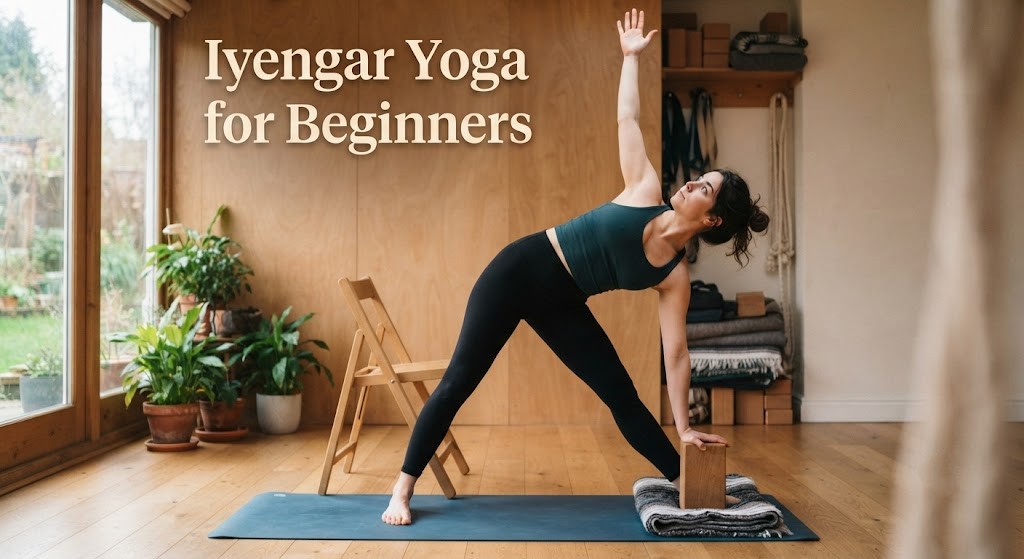
A block can support the lower hand in Trikonasana when reaching toward the floor disrupts your alignment. This allows you to maintain greater organization while exploring the pose.
Similarly, Warrior II can be practiced with a shorter stance if a longer stance makes it difficult to maintain control. Reducing the range can help you learn the pose without turning the practice into a flexibility test.
How Do You Start Iyengar Yoga as a Beginner?
You can start Iyengar Yoga by learning a small group of foundational poses, understanding basic alignment, using appropriate props, and practicing consistently at a manageable level.
A beginner Iyengar Yoga practice involves learning foundational poses progressively, maintaining attentive alignment, and using modifications or props when they improve stability and accessibility.
Rather than attempting a demanding full session immediately, begin with a short practice. A 20–30 minute routine can introduce standing, seated, supported, and relaxation work without making the practice unnecessarily overwhelming.
For preparation, consider our 5 Minute Warm Up Before Workout before beginning your sequence.
How Long Should Beginners Practice Iyengar Yoga?
Beginners can start with approximately 20–30 minutes of practice and gradually increase duration as their comfort and understanding improve.
For example, three short sessions per week may be more sustainable than attempting an exhausting daily routine.
There is no single practice duration that works for everyone. Consistency, technique, recovery, and the ability to maintain attentive practice matter more than simply accumulating minutes.
How Are Props Used in Iyengar Yoga?
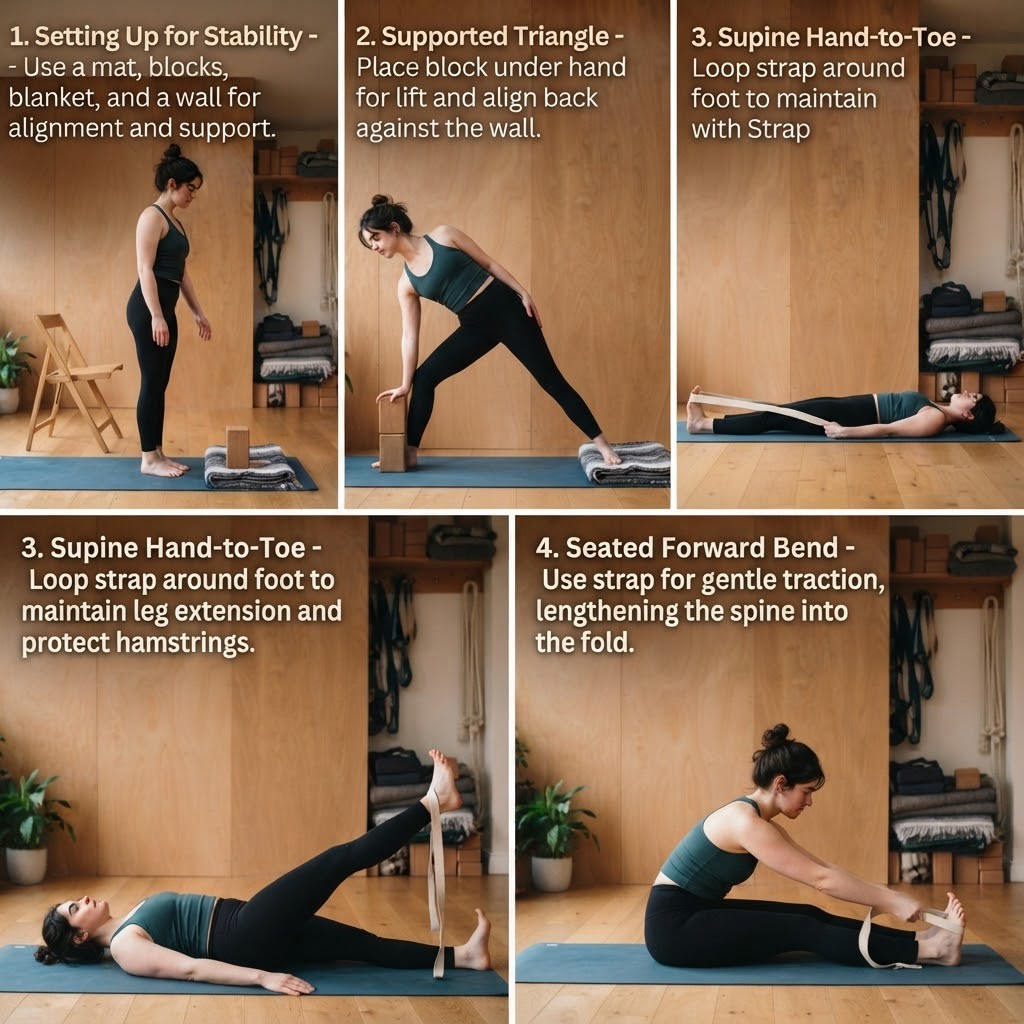
Iyengar Yoga props such as blocks, straps, blankets, bolsters, chairs, and walls can help practitioners modify poses and work toward appropriate alignment and stability.
Props are not signs that you are unable to perform yoga. They are tools for learning and refining movement.
For example:
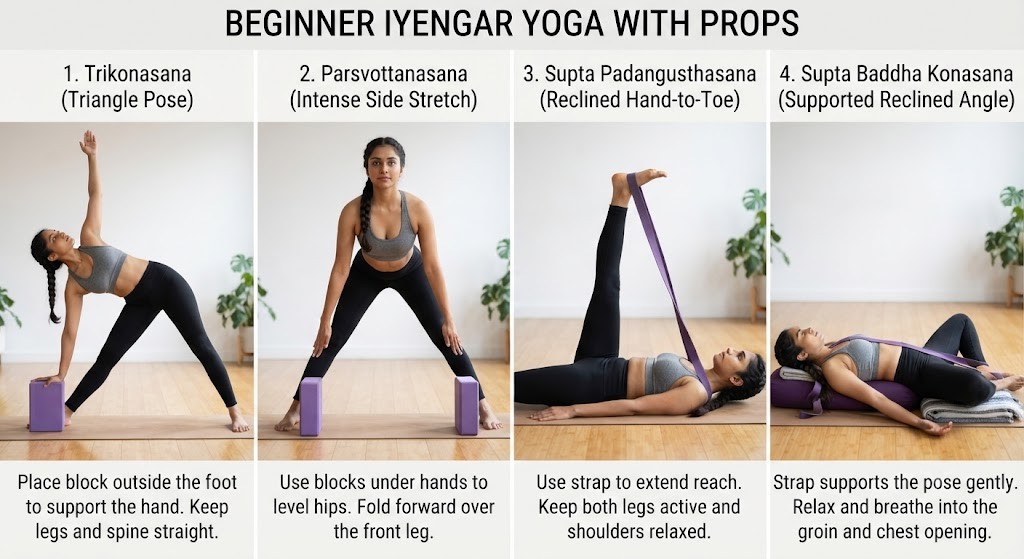
- A block can bring the floor closer during Trikonasana.
- A strap can help maintain an accessible hand position when the shoulders or hamstrings are tight.
- A blanket can provide cushioning or elevation.
- A bolster can provide support during restorative work.
- A chair can offer additional support in selected postures.
- A wall can provide balance and alignment feedback.
What Equipment Do Beginners Need for Iyengar Yoga?
The basic equipment for beginners includes a yoga mat, blocks, a strap, and a blanket. Bolsters, chairs, and walls can provide additional support.
Many Iyengar studios provide several types of props for students, so you may not need to purchase everything before attending a class.
A useful beginner setup includes:
- Yoga mat for a stable practice surface.
- Two blocks for support and positioning.
- One strap for accessible arm or leg actions.
- One blanket for cushioning and elevation.
- Wall space for balance and alignment feedback.
Can You Practice Iyengar Yoga at Home as a Beginner?
Yes, you can practice Iyengar Yoga at home as a beginner if you keep the sequence simple, use stable props, and avoid attempting advanced poses without appropriate instruction.
A clear space, wall, mat, blocks, strap, and blanket can provide a practical home setup. You can begin with foundational postures and focus on understanding their basic actions rather than trying to replicate an advanced class.
However, home practice should complement—not necessarily replace—qualified instruction. A teacher can observe details that are difficult to identify by yourself, especially while you are still learning foundational alignment.
What Should You Expect in Your First Iyengar Yoga Class?
Your first Iyengar Yoga class will usually involve detailed instruction, foundational postures, alignment corrections, and appropriate use of props.
Iyengar Yoga classes for beginners are designed to introduce postures progressively rather than test flexibility or athletic ability.
Before class, tell your teacher about relevant physical limitations. Iyengar Yoga UK specifically recommends informing teachers about conditions such as blood-pressure issues, back, neck, or knee problems so adaptations can be considered.
How Can Beginners Practice Iyengar Yoga Safely?
Beginners can practice Iyengar Yoga safely by progressing gradually, avoiding forced range of motion, breathing naturally, and using modifications when necessary.
Comfortable progression is more important than achieving a deeper version of a pose.
Follow these basic principles:
- Start with foundational postures.
- Progress gradually.
- Use props when they improve stability or accessibility.
- Avoid forcing your range of motion.
- Maintain comfortable breathing.
- Stop or modify a movement if you experience sharp, sudden, or concerning pain.
- Avoid comparing your range of motion with another student’s.
- Seek qualified instruction when possible.
If you are returning after an injury or have a medical condition, appropriate professional guidance is particularly important. Yoga research can support general benefits, but it does not mean every pose is appropriate for every person.
What Are the Most Common Iyengar Yoga Mistakes Beginners Make?
Common Iyengar Yoga mistakes include forcing flexibility, ignoring alignment, treating props as optional weaknesses, rushing through poses, and copying another person’s range of motion.
Each mistake can reduce the learning value of the practice.
For example, forcing your hands toward the floor in Uttanasana can distract you from maintaining an appropriate spinal and leg position. Using blocks instead can allow you to explore the pose more effectively.
Avoid these common errors:
- Chasing depth instead of alignment
- Holding the breath during difficult poses
- Using unstable household objects as props
- Skipping preparation
- Advancing too quickly
- Ignoring pain or unusual symptoms
- Comparing your body with another practitioner’s body
The goal of beginner practice is not to make every pose look identical. Instead, focus on learning the actions, developing awareness, and gradually becoming more confident.
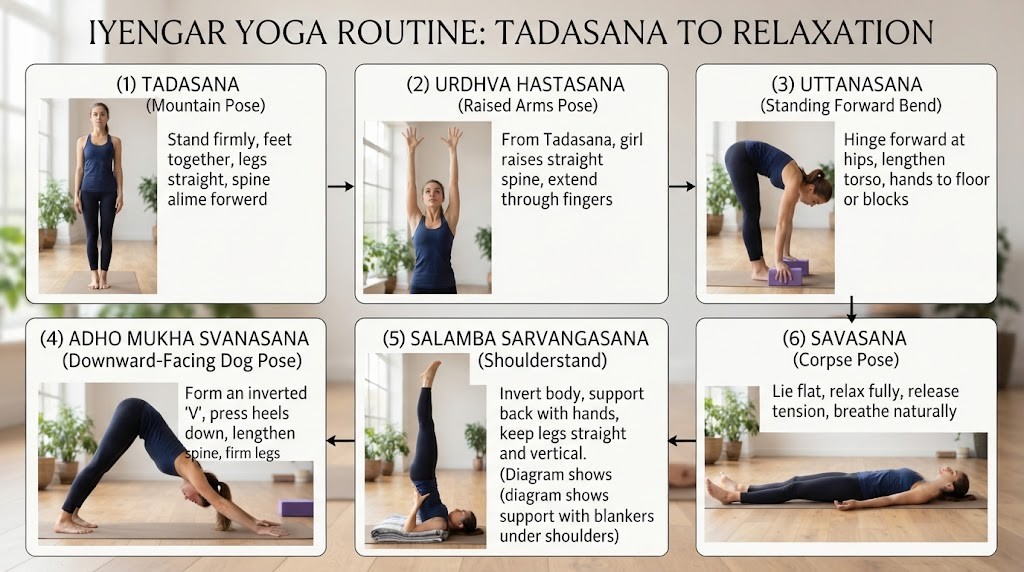
What Does a Beginner Iyengar Yoga Routine Look Like?
A beginner Iyengar Yoga routine combines simple standing, seated, supported, and relaxation poses in a progressive sequence.
A simple sequence should develop awareness first and intensity gradually rather than beginning with advanced postures.
Here is an introductory structure:
| Practice | Approximate Time | Beginner Focus |
|---|---|---|
| Centering and natural breathing | 2–3 min | Settle attention |
| Tadasana | 2–3 min | Standing alignment |
| Trikonasana | 2–3 min each side | Stability and extension |
| Virabhadrasana II | 2–3 min each side | Leg strength |
| Uttanasana | 2 min | Forward bending |
| Dandasana | 2 min | Seated alignment |
| Supported Bridge | 3–5 min | Supported back-body work |
| Relaxation | 5 min | Recovery and observation |
First, practice slowly and use blocks whenever they make the position more stable. Next, rest between poses when needed rather than treating the sequence as a continuous workout.
For a gentle start to the day, explore our morning yoga routine. After practice, yoga recovery can provide additional recovery ideas.
What Are the Best Tools and Practical Applications for Beginners?
The best tools for beginner Iyengar Yoga are simple, stable props that make alignment easier to understand and maintain. You do not need an expensive home studio to begin.
At home, a wall can help with standing balance and alignment, while blocks can raise the floor and blankets can provide support. A strap can extend your reach without forcing your joints into a position they cannot comfortably maintain.
A yoga prop should make an intended action more accessible, stable, or observable. This principle makes props useful learning tools rather than accessories.
What’s Next After Starting Iyengar Yoga?
The best way for a beginner to progress in Iyengar Yoga is to practice consistently, increase difficulty gradually, and learn the method from qualified instruction when available.
Progress should be measured by better awareness and control, not simply by performing harder poses.
Start by repeating a small group of foundational postures until their basic actions become familiar. Then gradually expand your pose vocabulary and learn how different sequences affect your practice.
Conclusion
Iyengar Yoga for beginners provides a structured way to learn yoga through alignment, precision, sequencing, observation, and thoughtful use of props. The method does not require advanced flexibility, and beginners can modify foundational poses to suit their current abilities.
Research on yoga suggests potential benefits for balance, flexibility, strength, mobility, and aspects of mental well-being, although results vary by population, intervention, and yoga style.
Most importantly, precision does not mean perfection. By practicing patiently, using props without hesitation, and learning from qualified instruction when available, you can build a stronger foundation for mobility, awareness, and confidence.
Whether you practice for 20 minutes at home or attend a structured class, focus on understanding each posture rather than rushing toward the next one. With consistency and mindful progression, Iyengar Yoga can become a practical way to develop a more informed, controlled, and confident yoga practice.
FAQs
What is Iyengar Yoga for beginners?
Iyengar Yoga for beginners focuses on alignment, precision, controlled movement, and props to make yoga accessible.
Is Iyengar Yoga suitable for complete beginners?
Yes. It starts with foundational poses and does not require advanced flexibility.
What is so special about Iyengar Yoga?
Its focus on precise alignment, detailed instruction, sequencing, and supportive props makes it distinctive.
What is Iyengar Yoga?
Iyengar Yoga is a yoga method developed by B.K.S. Iyengar that emphasizes alignment, precision, and props.
How is Hatha Yoga different from Iyengar Yoga?
Hatha Yoga is a broad style, while Iyengar Yoga emphasizes detailed alignment, precision, and props.
What are some famous Iyengar Yoga poses?
Tadasana, Trikonasana, Uttanasana, Virabhadrasana II, Dandasana, and Setu Bandha Sarvangasana are popular poses.
What are the best Iyengar Yoga poses for beginners?
Tadasana, Uttanasana, Trikonasana, Warrior II, Dandasana, and supported Bridge Pose are good starting poses.
Do I need to be flexible to start Iyengar Yoga?
No. Props and modifications make Iyengar Yoga accessible to different flexibility levels.
What props are used in Iyengar Yoga?
Common props include blocks, straps, blankets, bolsters, chairs, and walls.
Can I practice Iyengar Yoga at home?
Yes. Beginners can practice simple poses at home with basic props and proper guidance.
How long should a beginner practice Iyengar Yoga?
Beginners can start with about 20–30 minutes and gradually increase their practice time.
Is Iyengar Yoga good for flexibility?
Yes. Regular yoga practice can help improve flexibility and mobility.
Does Iyengar Yoga help with posture?
Yes. Its emphasis on alignment and body awareness can improve posture awareness.
Is Iyengar Yoga difficult for beginners?
It can be challenging, but props and detailed instruction help beginners progress gradually.
How often should beginners do Iyengar Yoga?
Beginners can start with several short sessions per week and gradually build consistency.
What should I wear for Iyengar Yoga?
Wear comfortable clothing that allows unrestricted movement and makes alignment easy to observe.
Can Iyengar Yoga help with balance?
Yes. Its focus on alignment, stability, and controlled movement can support balance development.
What is the main goal of Iyengar Yoga?
Its goal is to develop greater awareness and control through precise, mindful practice.
What is the biggest mistake beginners make in Iyengar Yoga?
A common mistake is forcing poses instead of focusing on alignment, comfort, and gradual progress.